The art market's preference for young artists has been a recent topic on a couple of other art blogs. Edward Winkleman has an open thread, Hatin' how they love them Youngins and Lisa Hunter has picked the theme up on The Intrepid Art Collector blog with Deja vu all over again.
I started to respond to Lisa's remark "... doesn't anyone besides me remember the 80s? It was the same when we were 20. Jean-Michel Basquiat, Keith Haring, Jeff Koons -- they were all in their 20s when they got famous…" but my thoughts rambled on to long for a comment.
(Lisa) You're right with the personalities, this was true also in the 60's Johns, Rauschenberg, Stella, Poons were all young as well. It might be generational. Typically artists near the age of 30 are the ones making the waves, setting the new stylistic trends. There are some big differences in how the art educational system and the business of art itself has changed over the last 40 years.
In the 1960's, the idea of being an artist as a "career" didn't really exist. By "career" I mean something akin to being a engineer at IBM, or an accountant, where if you got a college degree, you would get a job and a rung somewhere on the corporate ladder. By contrast, art schools, including the few universities which even had an MFA program, primarily taught art fundamentals and art history, the techniques of the trade, any mention of survival after graduation was anecdotal.
In the 1980's, partly as a result of the success of Minimalism, POP Art and Conceptual art, along with the appearance of new magazines like ArtForum, young artists came out of art schools with some idea that being an artist was a career. I think that in the mid 70's some of the art schools at least made an informal attempt to educate their students on what they should do to enter the system. That if you did the "right things" and made decent work, you could get a job (gallery) or even dream of being on the cover of ArtForum.
Fast forward, at the present, in addition to art fundamentals, the art schools also cover, either directly or indirectly, topics more directly related to establishing an art career including "art theory". The MFA has become a variant of the MBA and the "best students" from the "best schools" will get the "best jobs" This appears to be currently true.
The second major difference concerns the art business itself.
In the post WWII period, starting in the 1950's, with the shift in focus from Paris to the US (New York), the art business has grown substantially. Each of the three periods I outlined above, was marked by an increasing amount of capital purchasing "new art" As this trend developed, it became apparent that there could be a substantial return on investment if a collector purchased the early work of an artist who later became prominent. (hot)
This may seem like an obvious conclusion but it is not quite the case. In Los Angeles in the 1960's, the Irving Blum Gallery gave Andy Warhol his first exhibition of the Soup Cans. I think a few were slated to be sold (at around a $100 each but I could be wrong about that) when Mr. Blum decided that the set of 30 (??) paintings should be kept together and bought them himself. In essence he became a collector rather than a dealer. A collector, not a speculator, for he held the paintings for at least 30 years (I vaguely recall they may have finally been donated to a museum, I'm not sure)
The 1980's saw the birth of the art speculator, as a class of clientele, and the use of the "auction" as a method of establishing or raising prices. Prices of "emerging artists" were "augmented" through the auction market. Artworks were bought from an artist or dealer, sometimes by 2-3 people who each owned a "share", put up for auction and bought back by another collector who wanted the "unavailable" work, obviously pricing took a big jump and the "art speculator" was born.
A rising price has an interesting psychological affect, it creates demand. In the late 1970's, Phillip Guston's dealer could not sell his late new paintings (the ones people today love) at a price of $10,000. Even though they were great paintings, it seems that there was not much interest, collectors wanted paintings in his "established style". On day, his dealer told him over the phone, "Phillip, I've just doubled the value of your inventory" and doubled the asking (retail) prices, the rest is history.
At the present, none of the above observations have been lost on either side. Young artists are taught/encouraged to develop "a body of work" and the means of marketing it as a product. (there is a wide ranging definition for the word "product") As long as the art market stays firm, the speculators are prepared to take advantage of the situation by snapping up the work presumably with the intent of selling it later.
The fact that artists have become careerist, in the corporate sense, helps reduce the purchase risk. I suspect that, in a hot market for an artist, access to the work becomes somewhat constrained and is afforded to the "best clients". Again this is not unusual, with the exception that the speculators have a decided interest in seeing prices appreciate and may help things along where possible.
I suppose one should view this as a win-win situation for all concerned, the gallery, the collector, the speculator and of course the artist. On the consumer end, I believe this is true a good art market and appreciating prices is beneficial. For the artist, I suspect it may be a double edge sword. On the one hand, for artists with a degree of emotional maturity, the financial success may allow them more time to develop their artwork, more time to experiment and confidence, which should not to be underestimated as a developmental force. On the other hand, the pressures of financial success may weigh on the young artist by creating constraints, stylistic and otherwise, for which they are not prepared.
Whatever, it is what it is. As long as the art market stays firm, good or bad, I suspect the situation will continue. Further, an historical precedent has been set, and even if the art market crashed, the situation will be the same when it arises from the ashes again.
Today is some young persons "good old days"

Saturday, June 24, 2006
Wednesday, June 21, 2006
More Gustav Klimt
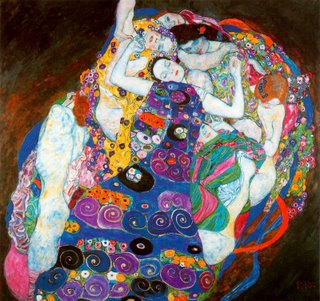
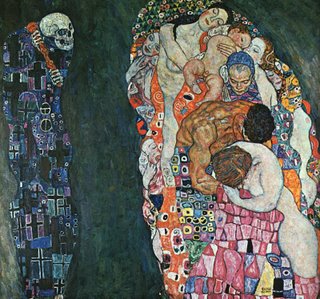
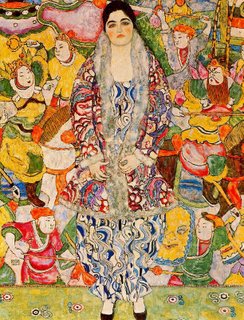
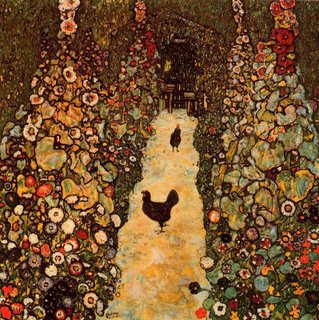
After the making the previous post, I thought it might be interesting to take a further look at some of Klimt's work. The stylistic focus on line and patterning made me think of the Dubuffet paintings I saw recently at Pace Gallery. Also at the time these paintings were made, the Japanese print had become to the forefront. In my view, Klimt took something from this but made it more uniquely personal.
It also occurred to me that at the moment the zeitgeist favors paintings which are have complicated linear detail. While Klimt may be dismissed by some as "decorative" there seems to be something here worth investigating, I'll append more to this commentary after I think about it awhile.
It also occurred to me that at the moment the zeitgeist favors paintings which are have complicated linear detail. While Klimt may be dismissed by some as "decorative" there seems to be something here worth investigating, I'll append more to this commentary after I think about it awhile.

Gustave Klimt, Austria. (1862-1918)
1913, The Maiden (Virgin)

Gustave Klimt, 1916,
Death and Life
In 1918 the "Spanish Flu" Influenza (1916-1918) becomes pandemic; over twenty-five million people die in the following six months (almost twice the number that died during World War I which was also raging at the time).

Gustave Klimt, 1916,
Portrait of Friedericke Maria Beer

Gustave Klimt, 1916,
Garden Path with Chickens
Monday, June 19, 2006
Gustav Klimt sets record
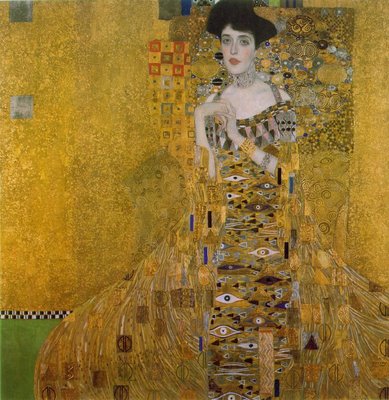
"A dazzling gold-flecked 1907 portrait by Gustav Klimt has been purchased for the Neue Galerie in Manhattan by the cosmetics magnate Ronald S. Lauder for $135 million, the highest sum ever paid for a painting."
From the New York Times, Monday June 19, 2006)

Some historical background from the Los Angeles County Museum including pictures of the other four paintings mentioned in the NY Times article
From the New York Times, Monday June 19, 2006)

Gustav Klimt, "Portrait of Adele Bloch-Bauer I" 1907,
Oil and gold on canvas 138 x 138 cm
Photo NY Times.

A different photograph of the same painting.
Photo art Archive.
Some historical background from the Los Angeles County Museum including pictures of the other four paintings mentioned in the NY Times article
Sunday, June 11, 2006
Nicole Eisenman at Leo Konig
Nicole Eisenman's new painting, Progress: Real and Imagined is heroic, both operatic in scope and monumental in scale. The best painting of the 2006 season.
Closes: June 17th, 2006
I went to Nicole Eisenman's opening, outside of reproductions, it was the first time had actually seen any of her work. While I was impressed with the scale of her new painting, it was hard to see because of the crowd. When I left, I wasn't sure what I thought of it. The memory of Progress: Real and Imagined stayed with me, like a gnawing in ones stomach, and I went back to see it again three more times. After my second viewing I knew I wanted to write something about it, but it took awhile to compose my thoughts.
Progress: Real and Imagined is a monumental painting, overall it is 8 feet high by 30 feet wide. It was painted on two canvases, the left is 16 feet wide and the right is shorter at just 14 feet, with a slight separation between the two. Generally, contemporary paintings of this scale, can be organized either as a permutative repetition of a conceptual idea which then becomes a pattern, as a visual field like Monet's Water Lilies, as the result of a physical process like pouring 20 gallons of paint on a canvas, or just by scaling the concept up. Eisenman's approach is none of the above.
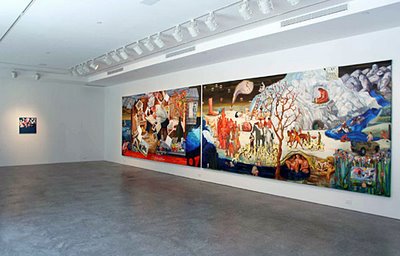
I viewed her painting again Saturday with a friend, another painter who admittedly had some difficulty with the work, but who also conceded that it was masterfully organized. I became curious whether this was just brilliantly intuitive, like Jean Michel Basquiat, or the result of an application of a more arcane geometry. What I found was that it is classically organized, referring back to the methods of the Renaissance. Eisenman uses a sequences of divisions, diagonals and the golden section, somewhat like the diagram I posted earlier on Fra Angelico as a scaffold for her paintings flood of images. A painting, with as complex aggregation of images like "Progress: Real and Imagined", requires a degree of organization which creates a visual resonance among its parts or it will fragment into chaos.
Initially I thought there might be some similarity of approach between Eisenman's painting and the paintings of Basquiat and Dubuffet. I mused over the speculation that all three used a "stream of consciousness" approach in creating their works. With Eisenman, this may be the case but discovering the underlying geometric structure of her painting, along with her more deliberate approach to realizing her imagery, leads me to believe it is more of an extension of the approach of these two artists than a direct similarity.
Another factor engendered by the large scale is time. Without knowing for a fact, I suspect "Progress: Real and Imagined" must have taken close to a year to realize. Since this painting is not a repetition of sequential permutations but rather an aggregation of images, the time spent in its execution probably had an affect on the development of the paintings imagery.
A little digression, that afternoon, I also saw Jenney Holtzer's exhibition "Archive" at Cheim & Read. The Saturday crowd of viewers were dutifully arrayed, necks craned, reading the text of the paintings. This struck me as somewhat odd, but there was text to be read and they did.
I also observed how the viewers looked at Eisenman's painting. Since there is nothing to be read sequentially, the dance was different, eyes darted as they walked along, back and forth, in front of the painting. I believe painting is a language, what do viewers see when they cannot read something? The viewer is compelled to reconcile an image, or sequences of images, to imply or decode meaning. A painting is a "random access" visual experience, imagery can be perceived non-sequentially without the structure of a grammar and is processed differently. The eye-brain decodes a gestalt, three dots and a line might be a face, and then proceeds with a cascade on finer distinctions which may eventually be classified linguistically. This also evokes the viewers experience and memory about images, about painting, other images and other experiences. It is a more fluid and complex process than just decoding a word.
Eisenman's imagery can frequently be raw, grating, horrific, disturbing, sexual and not always ingratiating for the viewer. When confronted with the complexity of a painting like "Progress: Real and Imagined", the viewer may suffer overload or the anxiety of interpretation. It is this anxiety which creates the emotional tension, is there progress? Is it real or imagined?
Reading from right to left, we scan from the caveman to the artist in the studio, is this progress? Or not, since reading in the more familiar mode from left to right, goes the other way encountering the more brutal signs of a throwback, a decapitated head and a severed foot. During the paintings gestation period, the news was flooded with stories of a continuing war, of atrocities, natural disasters and corruption. Paintings have a mind of their own, once started they take the artist in a direction, and either subconsciously or by intent, life events become part of the process. This is in part what I was referring to above about how the time affects the imagery of the painting. Is that just a vase with flowers in the center of the painting, or is it some dreadful fireworks from a bomb which just killed a family? This kind of recursive interpretation, could go on for hours, the painting is an sheaf of images capable of constantly unfolding to engage the viewer.
One final observation. "Progress: Real and Imagined" is also complex in its stylistic resolution. Eisenman's painting, firmly structured, runs the stylistic gauntlet from the sweeping to the intimate. The little "throwaway" pictures in the studio are fully resolved in their own right. Her painterliness traverses a range from cursory to crusty congealed passages. It is obvious these variations are by choice, not constraint, for her observational powers are keen as seen in the rendering of the jeans of the artist at work. By expanding her range of execution, she in effect, detaches it from "style" and allows it to function as a tool of expression.
Nicole Eisenman's painting, Progress: Real and Imagined is an ambitious statement, an expansion of her vision. It is the type of painting I was hoping to see at the start of a new century, it is Future Modern.
PS:
I wanted to extend a special thanks to James Wagner and Barry Hoggard for introducing me to the artist.
Closes: June 17th, 2006
I went to Nicole Eisenman's opening, outside of reproductions, it was the first time had actually seen any of her work. While I was impressed with the scale of her new painting, it was hard to see because of the crowd. When I left, I wasn't sure what I thought of it. The memory of Progress: Real and Imagined stayed with me, like a gnawing in ones stomach, and I went back to see it again three more times. After my second viewing I knew I wanted to write something about it, but it took awhile to compose my thoughts.
Nicole Eisenman,“Progress: Real and Imagined”
Oil on canvas, 96 inches x 360 inches
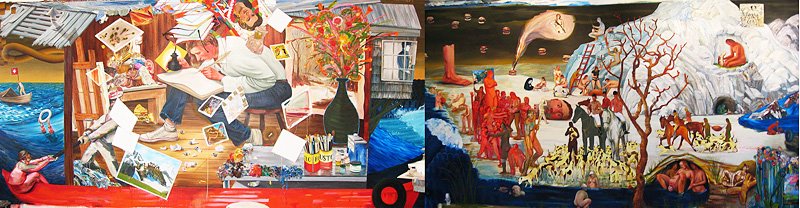
Progress: Real and Imagined is a monumental painting, overall it is 8 feet high by 30 feet wide. It was painted on two canvases, the left is 16 feet wide and the right is shorter at just 14 feet, with a slight separation between the two. Generally, contemporary paintings of this scale, can be organized either as a permutative repetition of a conceptual idea which then becomes a pattern, as a visual field like Monet's Water Lilies, as the result of a physical process like pouring 20 gallons of paint on a canvas, or just by scaling the concept up. Eisenman's approach is none of the above.

I viewed her painting again Saturday with a friend, another painter who admittedly had some difficulty with the work, but who also conceded that it was masterfully organized. I became curious whether this was just brilliantly intuitive, like Jean Michel Basquiat, or the result of an application of a more arcane geometry. What I found was that it is classically organized, referring back to the methods of the Renaissance. Eisenman uses a sequences of divisions, diagonals and the golden section, somewhat like the diagram I posted earlier on Fra Angelico as a scaffold for her paintings flood of images. A painting, with as complex aggregation of images like "Progress: Real and Imagined", requires a degree of organization which creates a visual resonance among its parts or it will fragment into chaos.
Initially I thought there might be some similarity of approach between Eisenman's painting and the paintings of Basquiat and Dubuffet. I mused over the speculation that all three used a "stream of consciousness" approach in creating their works. With Eisenman, this may be the case but discovering the underlying geometric structure of her painting, along with her more deliberate approach to realizing her imagery, leads me to believe it is more of an extension of the approach of these two artists than a direct similarity.
Another factor engendered by the large scale is time. Without knowing for a fact, I suspect "Progress: Real and Imagined" must have taken close to a year to realize. Since this painting is not a repetition of sequential permutations but rather an aggregation of images, the time spent in its execution probably had an affect on the development of the paintings imagery.
A little digression, that afternoon, I also saw Jenney Holtzer's exhibition "Archive" at Cheim & Read. The Saturday crowd of viewers were dutifully arrayed, necks craned, reading the text of the paintings. This struck me as somewhat odd, but there was text to be read and they did.
I also observed how the viewers looked at Eisenman's painting. Since there is nothing to be read sequentially, the dance was different, eyes darted as they walked along, back and forth, in front of the painting. I believe painting is a language, what do viewers see when they cannot read something? The viewer is compelled to reconcile an image, or sequences of images, to imply or decode meaning. A painting is a "random access" visual experience, imagery can be perceived non-sequentially without the structure of a grammar and is processed differently. The eye-brain decodes a gestalt, three dots and a line might be a face, and then proceeds with a cascade on finer distinctions which may eventually be classified linguistically. This also evokes the viewers experience and memory about images, about painting, other images and other experiences. It is a more fluid and complex process than just decoding a word.
Eisenman's imagery can frequently be raw, grating, horrific, disturbing, sexual and not always ingratiating for the viewer. When confronted with the complexity of a painting like "Progress: Real and Imagined", the viewer may suffer overload or the anxiety of interpretation. It is this anxiety which creates the emotional tension, is there progress? Is it real or imagined?
Reading from right to left, we scan from the caveman to the artist in the studio, is this progress? Or not, since reading in the more familiar mode from left to right, goes the other way encountering the more brutal signs of a throwback, a decapitated head and a severed foot. During the paintings gestation period, the news was flooded with stories of a continuing war, of atrocities, natural disasters and corruption. Paintings have a mind of their own, once started they take the artist in a direction, and either subconsciously or by intent, life events become part of the process. This is in part what I was referring to above about how the time affects the imagery of the painting. Is that just a vase with flowers in the center of the painting, or is it some dreadful fireworks from a bomb which just killed a family? This kind of recursive interpretation, could go on for hours, the painting is an sheaf of images capable of constantly unfolding to engage the viewer.
One final observation. "Progress: Real and Imagined" is also complex in its stylistic resolution. Eisenman's painting, firmly structured, runs the stylistic gauntlet from the sweeping to the intimate. The little "throwaway" pictures in the studio are fully resolved in their own right. Her painterliness traverses a range from cursory to crusty congealed passages. It is obvious these variations are by choice, not constraint, for her observational powers are keen as seen in the rendering of the jeans of the artist at work. By expanding her range of execution, she in effect, detaches it from "style" and allows it to function as a tool of expression.
Nicole Eisenman's painting, Progress: Real and Imagined is an ambitious statement, an expansion of her vision. It is the type of painting I was hoping to see at the start of a new century, it is Future Modern.
Nicole Eisenman "Untitled" 2006
Oil on Canvas, 18 inches x 14 inches
All photos from the Leo Konig Gallery website, used without permission

PS:
I wanted to extend a special thanks to James Wagner and Barry Hoggard for introducing me to the artist.
Saturday, May 13, 2006
Dubuffet and Basquiat at Pace Wildenstein
Pace Wildenstein has a wonderful exhibition of paintings Dubuffet and Basquiat: Personal Histories on view at the 25th Street gallery through June 17, 2006. It is a remarkable pairing of two artists of different generations with a surprisingly similar approach to image making, painting. The Dubuffet's from the mid 70's, are great paintings. Don't miss this show.

Jean Dubuffet "Mêle moments", 1976
Mixed media on canvas 98 x 142" (248.9 x 360.7 cm)

Jean Dubuffet "Les lieux conjugés", 1976
Acrylic and paper collage on canvas 97-1/2" x 98" (248 cm x 249 cm)

Jean Dubuffet Panorama, January 20, 1978
Acrylic and paper collage on canvas 82-1/2" x 111-1/2" (209.6 cm x 283.2 cm)

Jean Dubuffet La féconde journée, 1976
Acrylic and paper collage on canvas 80-1/2" x 83" (204.5 cm x 210.8 cm)
All images are from the Pace Wildenstein website and used without permission.
Space, the Final Frontier
The Beginning of Time: String Theory
I've been reading The Elegant Universe, Brian Greene's wonderful book on string theory. A quick description quoted from the publishers comments on the back cover:
This was my third reading and each time I came away with a deeper insight of quantum theory and a sense of awe that mankind can even conceive of such a far reaching theoretical description of the universe. The universe as something as opposed to nothing, not just a universe of stars, but corporeality itself.
At the beginning of the last century physics was relatively simple, matter was viewed in a way similar to the Greek concept of atoms. Of course scientists, being a curious lot, found a way to break apart the atom into smaller particles, neutrons, protons and electrons, but it didn’t stop there and particle smashing became a part of experimental physics for the next century.
As one might suspect, experimental physicists kept finding more and more subatomic particles, the little pieces which made up the atomic particles, quarks, muons… and things became complicated rather quickly. Up to this point we are still using a model we can easily visualize by playing around with some styrofoam balls. Consider the photon, the particle for light, and everything goes awry. Light sometimes behaves like a waveform, this can be verified by experiment but it is also can be viewed as a particle which also can be tested by experiment. In 1927, Werner Heisenberg and Niels Bohr proposed the Uncertaity Principle which in essence states that you cannot measure properties which define both states at the same time. Things are now starting to become interesting, as these chameleon like properties, become evident only when viewed statistically, sometimes they are here, sometimes they are there, but if you measure them, you freeze a particular state.
Richard Feynman was awarded the Nobel Prize for physics for his work on Quantum electrodynamics which offers a solution to the problem above by suggesting that light takes all possible paths to its destination and what the scientist observes is the statistical sum of all of them. Right about here one has to leave a common sense world view behind, welcome to quantum physics. As counter-intuitive this seems in a Newtonian world view , it was a theory which helped make, among other things, the transistor possible. However, in spite of the early achievements in quantum theory, there were several unexplained questions and all the macro-micro views did not all quite fit together, in particular Gravity was problematic. In physics, one often finds big theoretical problems are caused by mathematical solutions which give "undefined" results, like dividing a number by zero. Infinity is the bane of the mathematical theorist. For example, when a star collapses into a black hole its density, mass/volume, which might shrink to zero, becomes infinite. While this may not be precisely correct, it does describe one of the problems which occurs when trying to formulate an all inclusive quantum theory, the holy grail of physics, the TOE, the theory of everything.
Enter string theory
Brian Green picks it up from there, leading the reader through the historical developments as well as the mind boggling mathematical and conceptual constructs which make string theory a viable possibility for a TOE.
String theory, or M-Theory as it is now called, is an appealing conceptualization which piqued my interest in several areas. For one, a string, as far as I can understand, isn't anything at all. It is not really a "thing" or made of something, rather it is a vibration in space, if it ceases to vibrate, like a guitar string it is silent, it ceases to exist. If it vibrates, it possess energy and since energy and matter are related, it becomes something.
In order to keep the bookkeeping straight, eliminate those pesky infinities and to unify all the forces including gravity, Edward Witten and others proposed an 11 dimensional space to contain reality as we know it. The expanded dimensions, three space dimensions, plus the time dimension are what we experience, the other seven dimensions are described as being "curled up", or super small. Visualizing 11 dimensions is wickedly difficult, the mathematicians can describe them mathematically, but trying to visualize them is more or less impossible. I think it is possible to understand their implications, they allow the strings to exist and as such they allow the world to exist.
So I asked myself, what was there before the big bang? Nothing? I like the idea of nothing. So suppose we have nothing, by nothing I mean nothing, no space, no time, nothing. "Let there be space" and there was space. The will of a supreme being, or just chance, that is all it would take, because once there is space, everything else follows. Since strings require space, but are not made from space, they just vibrate in space, the shock of the initial creation of space sets everything into vibration, the vibration creates energy and matter, and must expand. Something from nothing, it's a start, the grand inflation leading to the separation of the primary forces, gravity and matter, it is all just space buzzing at one frequency or another. What a grand idea.
I've been reading The Elegant Universe, Brian Greene's wonderful book on string theory. A quick description quoted from the publishers comments on the back cover:
"In a rare blend of scientific insight and writing as elegant as the theories it explains, Brian Greene, one of the worlds leading string theorists, and author of the forthcoming the Fabric of the Cosmos, peels away layers of mystery surrounding string theory to reveal a universe that consists of eleven dimensions, where the fabric of space tears and repairs itself and all matter - from the smallest quarks to the most gargantuan supernova - is generated by the vibrations of microscopically tiny loops of energy.
This was my third reading and each time I came away with a deeper insight of quantum theory and a sense of awe that mankind can even conceive of such a far reaching theoretical description of the universe. The universe as something as opposed to nothing, not just a universe of stars, but corporeality itself.
At the beginning of the last century physics was relatively simple, matter was viewed in a way similar to the Greek concept of atoms. Of course scientists, being a curious lot, found a way to break apart the atom into smaller particles, neutrons, protons and electrons, but it didn’t stop there and particle smashing became a part of experimental physics for the next century.
As one might suspect, experimental physicists kept finding more and more subatomic particles, the little pieces which made up the atomic particles, quarks, muons… and things became complicated rather quickly. Up to this point we are still using a model we can easily visualize by playing around with some styrofoam balls. Consider the photon, the particle for light, and everything goes awry. Light sometimes behaves like a waveform, this can be verified by experiment but it is also can be viewed as a particle which also can be tested by experiment. In 1927, Werner Heisenberg and Niels Bohr proposed the Uncertaity Principle which in essence states that you cannot measure properties which define both states at the same time. Things are now starting to become interesting, as these chameleon like properties, become evident only when viewed statistically, sometimes they are here, sometimes they are there, but if you measure them, you freeze a particular state.
Richard Feynman was awarded the Nobel Prize for physics for his work on Quantum electrodynamics which offers a solution to the problem above by suggesting that light takes all possible paths to its destination and what the scientist observes is the statistical sum of all of them. Right about here one has to leave a common sense world view behind, welcome to quantum physics. As counter-intuitive this seems in a Newtonian world view , it was a theory which helped make, among other things, the transistor possible. However, in spite of the early achievements in quantum theory, there were several unexplained questions and all the macro-micro views did not all quite fit together, in particular Gravity was problematic. In physics, one often finds big theoretical problems are caused by mathematical solutions which give "undefined" results, like dividing a number by zero. Infinity is the bane of the mathematical theorist. For example, when a star collapses into a black hole its density, mass/volume, which might shrink to zero, becomes infinite. While this may not be precisely correct, it does describe one of the problems which occurs when trying to formulate an all inclusive quantum theory, the holy grail of physics, the TOE, the theory of everything.
Enter string theory
In 1968, theoretical physicist Gabriele Veneziano was trying to understand the strong nuclear force when he made a startling discovery. Veneziano found that a 200-year-old formula created by Swiss mathematician Leonhard Euler (the Euler beta function) perfectly matched modern data on the strong force. Veneziano applied the Euler beta function to the strong force, but no one could explain why it worked.
In 1970, Yoichiro Nambu, Holger Bech Nielsen, and Leonard Susskind presented a physical explanation for Euler's strictly theoretical formula. By representing nuclear forces as vibrating, one-dimensional strings, these physicists showed how Euler's function accurately described those forces.
Brian Green picks it up from there, leading the reader through the historical developments as well as the mind boggling mathematical and conceptual constructs which make string theory a viable possibility for a TOE.
String theory, or M-Theory as it is now called, is an appealing conceptualization which piqued my interest in several areas. For one, a string, as far as I can understand, isn't anything at all. It is not really a "thing" or made of something, rather it is a vibration in space, if it ceases to vibrate, like a guitar string it is silent, it ceases to exist. If it vibrates, it possess energy and since energy and matter are related, it becomes something.
In order to keep the bookkeeping straight, eliminate those pesky infinities and to unify all the forces including gravity, Edward Witten and others proposed an 11 dimensional space to contain reality as we know it. The expanded dimensions, three space dimensions, plus the time dimension are what we experience, the other seven dimensions are described as being "curled up", or super small. Visualizing 11 dimensions is wickedly difficult, the mathematicians can describe them mathematically, but trying to visualize them is more or less impossible. I think it is possible to understand their implications, they allow the strings to exist and as such they allow the world to exist.
So I asked myself, what was there before the big bang? Nothing? I like the idea of nothing. So suppose we have nothing, by nothing I mean nothing, no space, no time, nothing. "Let there be space" and there was space. The will of a supreme being, or just chance, that is all it would take, because once there is space, everything else follows. Since strings require space, but are not made from space, they just vibrate in space, the shock of the initial creation of space sets everything into vibration, the vibration creates energy and matter, and must expand. Something from nothing, it's a start, the grand inflation leading to the separation of the primary forces, gravity and matter, it is all just space buzzing at one frequency or another. What a grand idea.
Tuesday, May 09, 2006
Bids Breakup Blakes
In an earlier post I expressed my dismay over Sotheby's decision to sell the recently discovered suite of William Blake drawings separately because it was highly unlikely the nineteen drawings would be kept together. The sale was held on May 2, 2006 and as everyone expected the set of drawings was indeed broken up.
So how dideveryone the money people do? In typical bean counter fashion here is a spreadsheet with the final results.
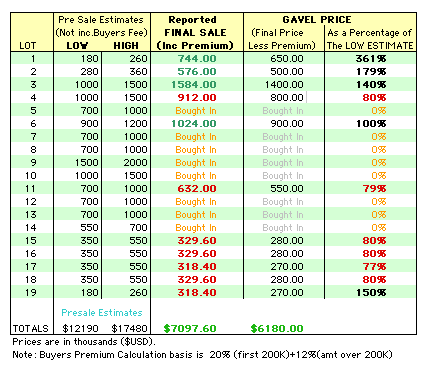
Now all the cards are on the table, from both a business and PR standpoint it would appear to me that since 40% of the offered lots were bought in, Sotheby's probably would have done better if they had insisted on selling the drawings as a group. (I must admit I know nothing of the backroom antics, certainly the speculator who owned the drawings wanted to realize the highest price possible, so…)
I would also note that of the 19 lots, only 5 (26%) were sold at, or above the presale low estimate. (The presale estimates do not include the "buyers premium" but the reported sales price does, so I Calculated a "Gavel Price" with no premium for the comparisons.) The speculators, who offered the Blake drawings for sale, are probably happy. It appears they have made back close to their original investment and still own eight of the drawings which they can peddle piecemeal to realize a profit on the bet. Business is business.
I suspect the sale probably was a bit of a disappointment for Sotheby's. After an initial buying frenzy, it appears the bidders felt that even the presale low estimates were a bit off the mark and became more cautious about raising the paddle. Or, the auction market is starting to soften, and the results from the sale of the Blake drawings are the first indication this may be the case. (… I know, Picasso and Van Gogh, but later on that…)
So how did
Now all the cards are on the table, from both a business and PR standpoint it would appear to me that since 40% of the offered lots were bought in, Sotheby's probably would have done better if they had insisted on selling the drawings as a group. (I must admit I know nothing of the backroom antics, certainly the speculator who owned the drawings wanted to realize the highest price possible, so…)
I would also note that of the 19 lots, only 5 (26%) were sold at, or above the presale low estimate. (The presale estimates do not include the "buyers premium" but the reported sales price does, so I Calculated a "Gavel Price" with no premium for the comparisons.) The speculators, who offered the Blake drawings for sale, are probably happy. It appears they have made back close to their original investment and still own eight of the drawings which they can peddle piecemeal to realize a profit on the bet. Business is business.
I suspect the sale probably was a bit of a disappointment for Sotheby's. After an initial buying frenzy, it appears the bidders felt that even the presale low estimates were a bit off the mark and became more cautious about raising the paddle. Or, the auction market is starting to soften, and the results from the sale of the Blake drawings are the first indication this may be the case. (… I know, Picasso and Van Gogh, but later on that…)
Subscribe to:
Posts (Atom)